

【Food Antioxidants Series 4】 A Classic Antioxidant Combination | BHA & BHT: A Powerful Pair for Fat and Oil Protection
Sep. 18, 2026
In modern food preservation systems for fat-rich foods, combining synthetic antioxidants is a widely used strategy to enhance oxidative stability and extend shelf life. Butylated Hydroxyanisole (BHA) and Butylated Hydroxytoluene (BHT) are a classic combination. With their complementary properties, they work synergistically to protect fats and oils from oxidation and have long been widely used in the food industry.
I. Butylated Hydroxyanisole (BHA) & Butylated Hydroxytoluene (BHT)
Butylated Hydroxyanisole (BHA), also known as tert-butyl-4-hydroxyanisole, is a mixture of two components, 3-BHA and 2-BHA [2]. Industrially, p-hydroxyanisole is used as the key starting material, and a tert-butyl group is introduced onto the benzene ring through a tert-butylation reaction. Acid-catalyzed synthesis is the mainstream production process, while greener modified processes, such as phase-transfer catalysis and solid-acid catalysis, have also been developed [9].
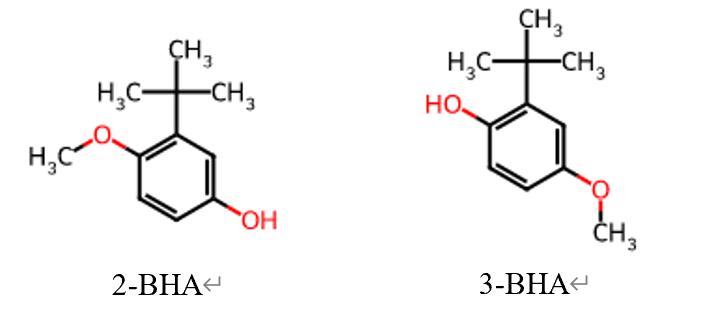
Image source: ChemSpider
Butylated Hydroxytoluene (BHT), also known as 2,6-di-tert-butyl-p-cresol, is also a synthetic phenolic oil-soluble antioxidant. Industrially, BHT is produced using p-cresol as the starting material, with isobutylene, tert-butanol (TBA), or methyl tert-butyl ether (MTBE) as alkylating agents. Under the action of an acid catalyst, it is synthesized through a Friedel–Crafts alkylation reaction [5].
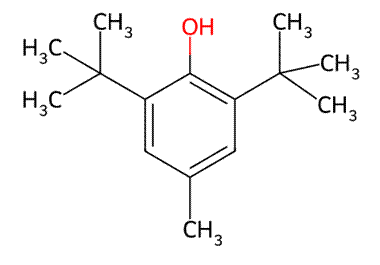
Image source: ChemSpider
II. Basic Properties
1. Physical Properties
BHA: A white crystalline solid or crystalline powder with a slight characteristic odor [4]. It has a melting point of 48–63°C and a boiling point of 265°C. It is insoluble in water, glycerol, and propylene glycol, but readily soluble in ethanol (25%) and fats/oils
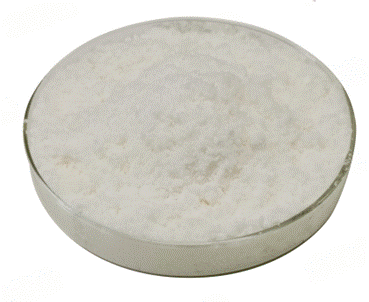
Image Source: L&P Food Ingredient Co., Ltd
BHT: A white crystalline solid or crystalline powder that is essentially odorless and tasteless. It has a melting point of 69–73°C and a boiling point of 265°C. It is practically insoluble in water and has excellent solubility in fats and oils [1].
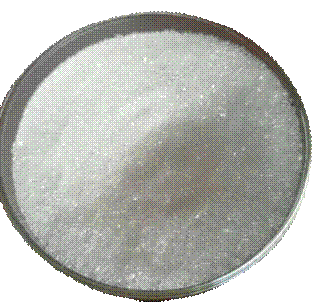
Image Source: Baidu Encyclopedia (Baidu Baike)
Both are oil-soluble antioxidants that require no additional solubilization treatment and can be readily incorporated into fat and oil systems.
2. Antioxidant Mechanism
BHA: Releases active hydrogen to capture free radicals during the initial stage of lipid oxidation, forming stable phenoxy radicals and terminating the initiation of oxidation [6].
BHT: Releases active hydrogen to selectively scavenge peroxy radicals during the intermediate stage of oxidation, forming relatively inert phenoxy radicals and interrupting the propagation of oxidative chain reactions [5].
Combination: BHA helps suppress the initiation of oxidation, while BHT interrupts the propagation of oxidation. The phenoxy radicals generated by each do not react with one another. By acting at different stages of oxidation, the two antioxidants work synergistically to enhance antioxidant performance and extend the shelf life of fat-rich foods.
3. Key Advantages
-
Strong synergistic effect: When used together, BHA and BHT provide sustained antioxidant protection and effective long-term preservation, making them suitable for foods requiring extended storage.
-
Broad compatibility with fats and oils: They are highly suitable for vegetable oils and various processed fats and oils, with particularly notable antioxidant performance in animal fats.
-
Good chemical stability: They are relatively resistant to discoloration caused by metal ions such as iron and copper.
4. Stability
Both BHA and BHT have good chemical stability and can be stored for extended periods under normal-temperature, dry, and light-protected conditions. However, their antioxidant activity may decrease under intense light, high-temperature and high-humidity conditions, or strongly alkaline conditions. BHA may undergo slight decomposition during prolonged exposure to light, while BHT is more readily oxidized in alkaline environments.
5. Other Properties
Both also exhibit a certain degree of antimicrobial activity, which may help support food hygiene and safety.
III. Regulatory Recognition: Established Guidelines for Use in China and International Markets
As well-established food antioxidants, BHA and BHT are recognized for use by various countries and international organizations worldwide. Clear provisions have been established regarding their permitted applications and maximum use levels, making them legally permitted and regulated food additives.
-
China: Both are included in GB 2760-2024, which specifies their permitted applications and maximum use levels. For various fat-rich foods, their use levels are calculated based on the fat or oil content and must strictly comply with the prescribed limits.
-
United States: They are recognized by the FDA as Generally Recognized as Safe (GRAS) substances and are permitted for use in fats, oils, and fat-rich foods within specified use levels.
-
European Union: Their use is governed by relevant EU food additive regulations and is restricted to specified categories such as edible oils, bakery products, and nuts.
-
International Standards: The Codex Alimentarius Commission (CAC) has established harmonized maximum use levels for BHA and BHT, while the Joint FAO/WHO Expert Committee on Food Additives (JECFA) has established their Acceptable Daily Intake (ADI), providing a scientific basis for their use worldwide [3].
IV. Safety: Safe for Consumption Within Permitted Limits
BHA: There has been some debate regarding its carcinogenicity assessment, and IARC classifies BHA as a Group 2B carcinogen. However, at the very low levels permitted in food applications, the associated carcinogenic risk is considered negligible, and normal dietary exposure is far below the doses associated with carcinogenic effects in experimental animals [7].
ADI (Acceptable Daily Intake): 0–0.5 mg/kg body weight.
BHT: IARC classifies BHT as a Group 3 substance, meaning that the available evidence is insufficient to determine its carcinogenicity to humans. When used at the low levels permitted by national standards, there is no clear evidence of carcinogenic, teratogenic, or mutagenic effects, and its safety has been recognized by major food safety authorities worldwide [7].
ADI (Acceptable Daily Intake): 0–0.3 mg/kg body weight.
V. Applications: Broad Coverage Across Fat-Rich Foods with Unified Maximum Use Levels
According to GB 2760-2024, the maximum use level for both BHA and BHT is 0.2 g/kg, calculated based on the fat or oil content. When BHA and BHT are used in combination, the applicable proportional-use requirements must be followed. Their applications cover a wide range of fat-rich foods, mainly including:
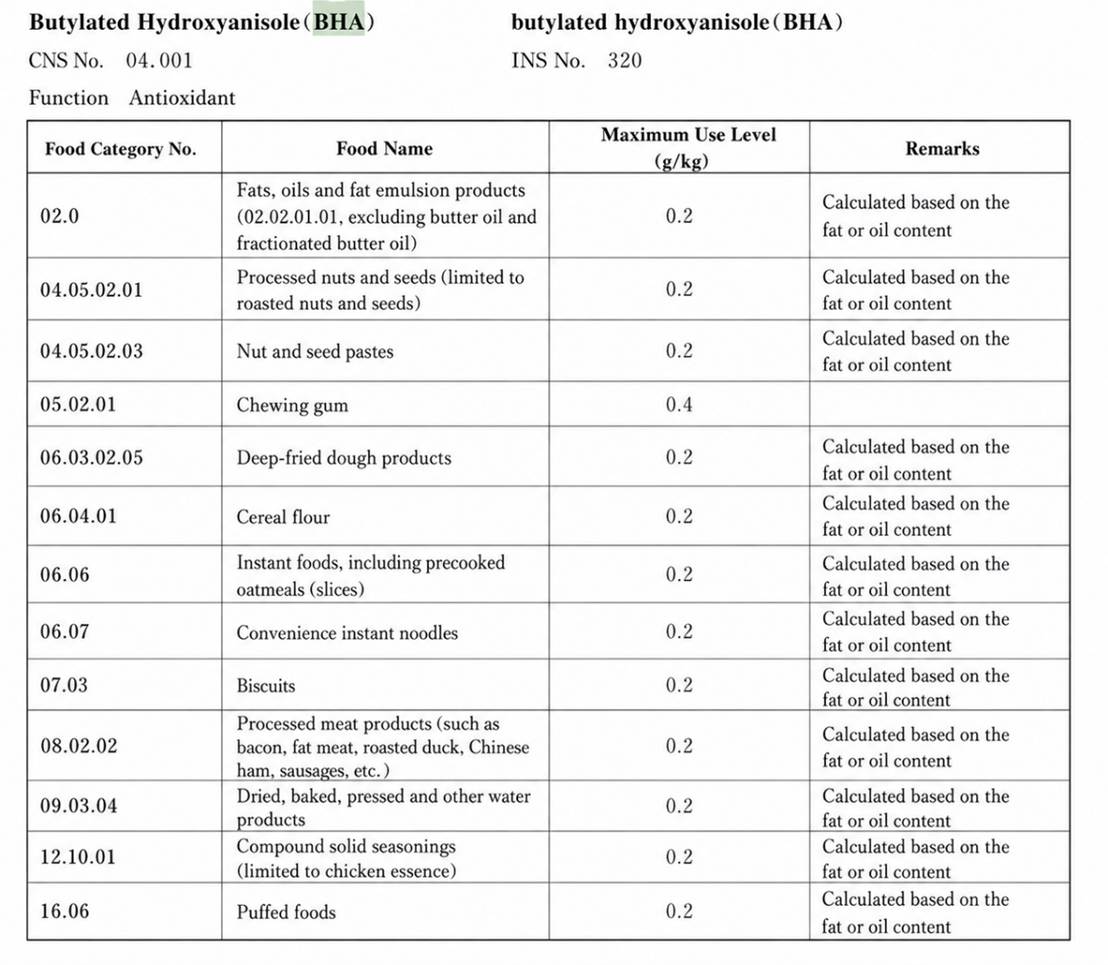
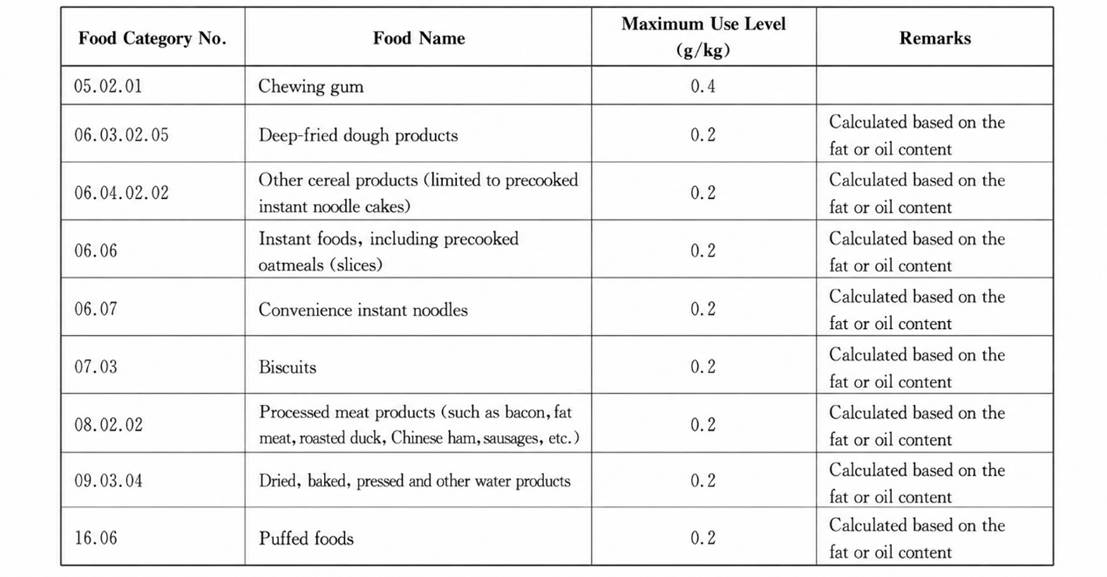
When used in combination, if BHA is used at 0.1 g/kg (50% of its maximum permitted level), the maximum amount of BHT must not exceed 0.1 g/kg (50% of its maximum permitted level). The sum of their respective proportions must equal 1 [8], in strict accordance with the requirements of the national standard.
According to the national standard, food manufacturers must clearly declare the use of BHA and BHT in the ingredient list to ensure consumers’ right to be informed.
VI. Key Points for Use: Scientific Application for Optimal Performance
The use of BHA and BHT should follow sound scientific principles to maximize their antioxidant performance while maintaining food quality. Five key points should be considered:
-
Ensure complete dissolution: Both are oil-soluble and should be fully dissolved in fats or oils before addition to avoid excessively high local concentrations that may affect food quality.
-
Strictly control dosage: When used individually, the amount of either antioxidant must not exceed 0.2 g/kg, calculated based on the fat or oil content. When used in combination, the principle that the “sum of the proportions ≤ 1” should be followed.
-
Use synergists where appropriate: Combining them with acidic substances such as citric acid or phosphoric acid can significantly enhance antioxidant activity. Citric acid can chelate metal ions, thereby reducing their catalytic effect on lipid oxidation.
-
Avoid unsuitable conditions: BHA is prone to decomposition under strongly alkaline conditions, while BHT may slowly oxidize upon exposure to light. During production and storage, exposure to light should be minimized and temperature should be controlled. Use under high-temperature or strongly alkaline conditions should be avoided.
-
Match the antioxidant to the type of fat or oil: Selection should be based on the type of fat or oil. BHA is preferred for animal fats, while BHT is preferred for the long-term storage of vegetable oils. Their combined use is suitable for various blended fats and oils.
BHA and BHT are a classic antioxidant combination in the food industry. With good cost-effectiveness, strong synergistic performance, and broad applicability, they are important options for preserving fat-rich foods. They are legally permitted food additives that have undergone authoritative safety evaluations and are subject to strict limits under national standards. When used in compliance with applicable requirements, they can help preserve food quality and shelf life while maintaining food safety. Consumers can purchase products through legitimate channels and check ingredient lists and shelf-life information for informed consumption. The scientific use of food additives helps keep our food choices diverse and fresh, reflecting the role of modern food technology in everyday life.
References:
[1]戴素仪.丁基羟基甲苯(BHT)稳定性及其在松香抗氧化中的应用研究[D].广西大学,2024.DOI:10.27034/d.cnki.ggxiu.2024.002691.
[2]XiaoJing Z ,MeiNing D ,YinFeng Z . A review of the occurrence, metabolites and health risks of butylated hydroxyanisole (BHA).[J].Journal of the science of food and agriculture,2023,103(13):6150-6166.DOI:10.1002/JSFA.12676.
[3]肖菁,吴卫国,彭思敏. 食用油抗氧化剂及其安全性研究进展[J].粮食与油脂,2021,34(09):10-13+17.
[4]洪伟图.叔丁基对苯二酚清洁生产工艺开发[D].厦门大学,2021.DOI:10.27424/d.cnki.gxmdu.2021.000581.
[5]Yehye A W ,Rahman A N ,Ariffin A , et al. Understanding the chemistry behind the antioxidant activities of butylated hydroxytoluene (BHT): A review[J].European Journal of Medicinal Chemistry,2015,101295-312.DOI:10.1016/j.ejmech.2015.06.026.
[6]梅艳,丁瑞,吴镝,等. 叔丁基羟基茴香醚对衰老大鼠肾脏缺血/再灌注损伤的保护作用[J].中国老年学杂志,2007,(09):809-811.
[7]李书国,赵文华,陈辉. 食用油脂抗氧化剂及其安全性研究进展[J].粮食与油脂,2006,(05):34-37.
[8]邓森元. 食品抗氧化剂[J].广州化工,2004,(02):53-55.
[9]夏英姿,蔡可迎,冯长君. 丁基羟基茴香醚的合成[J].精细石油化工进展,2001,(08):28-30.
最新ブログ
-
Sep. 18, 2026
【Food Antioxidants Series 5】 A New Force in Natural Antioxidants | Marigold Flavonoids
-
Sep. 18, 2026
-
Sep. 15, 2026
How TBHQ Extends Shelf Life in Oils and Snacks: Mechanism and Usage Tips
-
Sep. 07, 2026
-
Sep. 01, 2026